Dear AGORA community,
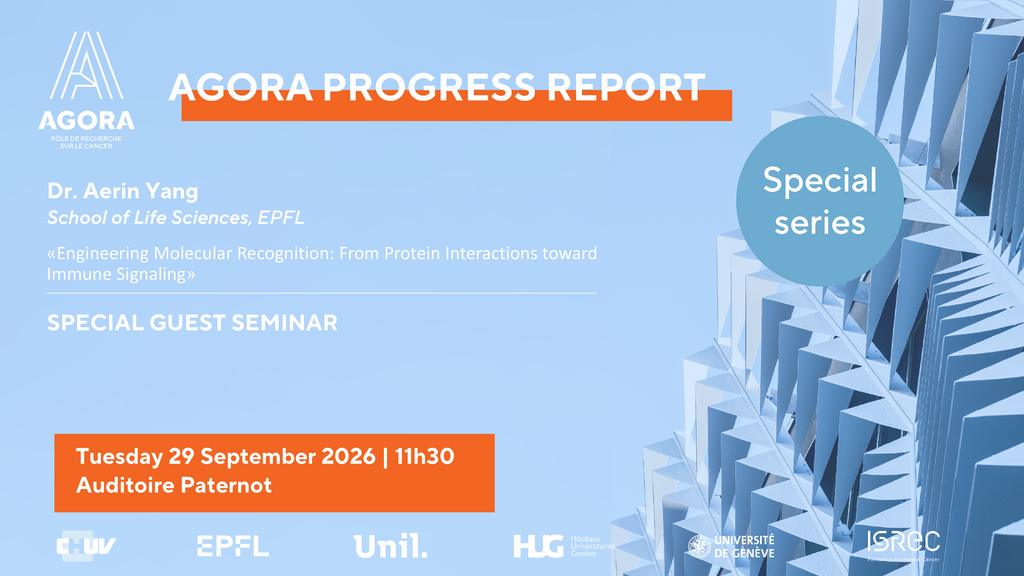
We are pleased to invite you to an AGORA PRS Special Guest Seminar on Tuesday, 29 September at 11:30, featuring Dr. Aerin Yang, Group Leader at the Institute of Bioengineering, School of Life Sciences, EPFL, hosted by Prof. Denis Migliorini.
ABSTRACT
The ability to systematically map and control protein–protein interactions is increasingly important for understanding immune recognition and engineering more precise cancer immunotherapies. Yet it remains challenging to understand how changes in protein sequence or chemical state reshape molecular interactions and function. My research has focused on developing experimental approaches to interrogate these relationships. We established chemical biology methods to generate proteins with precisely defined post-translational modifications, enabling direct analysis of how chemical changes alter protein function. More recently, we developed synthetic coevolution, in which interacting protein pairs are jointly diversified and selected to experimentally map protein–protein interaction landscapes. This approach allowed us to generate and engineer matched interaction pairs spanning diverse affinities and specificities, including orthogonal interactions, and to examine how sequence variation reshapes molecular recognition. By integrating large-scale interaction data with machine learning and structural analysis, we further uncovered how new interactions can emerge through distinct binding interfaces and docking geometries. Together, these studies provide an experimental framework for understanding and engineering the molecular interactions that underlie cellular recognition and signaling.
BIO
Aerin Yang is a Group Leader at the Institute of Bioengineering at EPFL, where she develops molecular technologies to understand and engineer immune recognition and signaling. Her research integrates chemical biology, protein engineering, and synthetic biology to control protein chemical states, map and engineer protein–protein interactions, and reprogram receptor signaling, with the broader goal of enabling more precise control of immune function. She received her BS and PhD in Chemistry from KAIST and conducted postdoctoral research with K. Christopher Garcia at Stanford University.
For further information please contact the AGORA team.