Dear all,
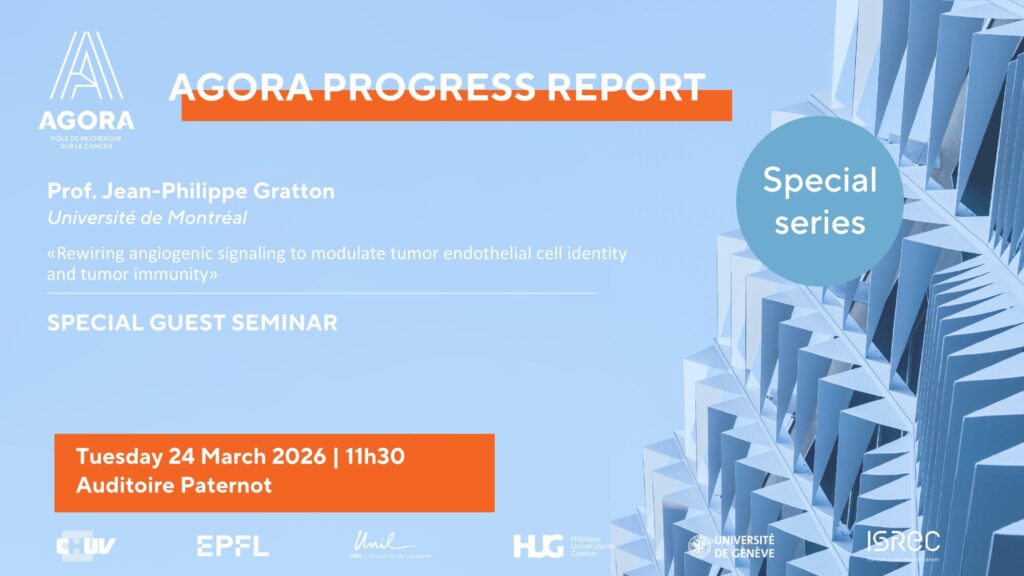
We are pleased to announce the AGORA PRS Special Guest Seminar on March 24th, presented by Prof. Jean-Philippe Gratton (Université de Montréal).
Seminar Title:
Rewiring angiogenic signaling to modulate tumor endothelial cell identity and tumor immunity
Host:
Miki De Palma
We hope to see many of you there!
For further information please contact the AGORA team.
ABSTRACT
Tumor angiogenesis supports the growth of solid tumors but generates a disorganized and dysfunctional vasculature with increased permeability caused by abnormal endothelial cell (EC) junctions. This abnormal vasculature also limits effective perfusion and immune cell infiltration. First, building on our long-standing interest in the signaling mechanisms underlying tumor vascular permeability, we investigated how the junctional protein Zonula occludens-1 (ZO-1) regulates EC function during angiogenesis. We found that ZO-1 controls stress granule formation and mRNA translation in ECs and contributes to vascular development in the mouse retina. We now show that EC-specific deletion of ZO-1 in tumors increases angiogenesis and tumor growth, while single-cell RNA-seq of tumor ECs reveals transcriptional reprogramming consistent with enhanced stress responses, reduced mRNA translation, and altered EC identity. Second, p21-activated kinase 2 (PAK2) is a critical regulator of intracellular signaling in ECs downstream of pro-angiogenic factors such as VEGF and angiopoietin-1. Endothelial deletion of PAK2 reduces tumor growth and angiogenesis while normalizing tumor vessels and promoting dendritic and NK cell infiltration through increased endothelial CXCL10 production. By identifying key modulators of angiogenic signaling in ECs, we define novel potential targets to reprogram ECs to limit tumor angiogenesis and reduce tumor burden.
BIO
Jean-Philippe Gratton received his Ph.D. in Pharmacology from the University of Sherbrooke (Quebec, Canada) and subsequently completed a postdoctoral fellowship at Yale University School of Medicine with Dr. William Sessa. In 2002, he joined the Institut de recherches cliniques de Montréal (IRCM), where he held the Canada Research Chair in Endothelial Cell Biology and Angiogenesis. In 2013, he relocated his laboratory to Université de Montréal, where he was appointed Full Professor and served as Chair of the Department of Pharmacology. From 2017 to 2025, he was Chair of the newly created Department of Pharmacology and Physiology of the Faculty of Medicine at Université de Montréal. His research focuses on identifying molecular mechanisms that regulate endothelial cell proliferation, differentiation, migration, and survival. This is achieved with the overall objective of uncovering key modulators of vascular development and of the angiogenic process in ischemic diseases or in cancerous tumors.