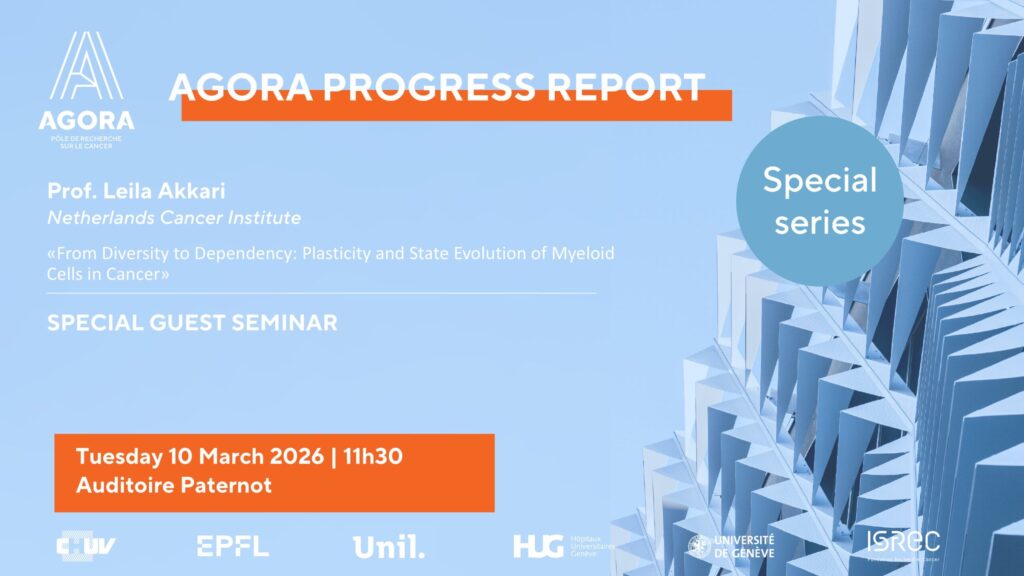
We are pleased to announce a Special Seminar on March 10, presented by Leila Akkari, Netherlands Cancer Institute
Seminar Title: “From Diversity to Dependency: Plasticity and State Evolution of Myeloid Cells in Cancer”
Join us for this exciting session exploring the dynamic roles of myeloid cells in cancer biology.
For further information please contact the AGORA team.
ABSTRACT
Tumors evolving within chronically damaged and metabolically constrained tissues depend on dynamic metabolic and signaling crosstalk between cancer cells and the immune microenvironment to sustain growth, evade immune control, and acquire therapeutic resistance. Our laboratory interrogates how tissue context, metabolic stress, and immune cell plasticity jointly shape tumor progression and response to therapy. Using integrated multi-omics, spatial profiling, and functional perturbation approaches across preclinical models of brain and liver cancer and complementary patient datasets, we map the spatiotemporal heterogeneity and lineage dynamics of tumor-infiltrating myeloid and lymphoid compartments. We identify metabolically rewired tumor-associated macrophage, myeloid, and regulatory T cell states that emerge during disease progression and treatment and actively drive immune suppression and resistance to both standard-of-care and immunotherapies. By defining the principles governing immune–metabolic co-evolution in tumors, our work aims to uncover context-specific vulnerabilities that can be leveraged to reprogram the tumor microenvironment and restore durable therapeutic responses.
BIO
Leila Akkari is a group leader at the Netherlands Cancer Institute in the Tumor Biology and Immunology department, Full Professor at Leiden University and a Senior Member of the Oncode Institute. Her research focuses on innate immune cell plasticity applied to the biology of cancers, using murine models of primary brain and liver cancers. Her group investigates and targets the functions of these immune cells in tumor maintenance and therapeutic resistance in order to identify therapeutic vulnerabilities to exploit. Her lab particularly focuses on tumor-associated macrophage versatile phenotypes and functions. She has been awarded several recognitions, such as The Dutch Cancer Society Young Investigator Award (2018), selection to the EMBO Young Investigatory Program, an ERC SYNergy grant from the European Union (2023), and the Ammodo Award for Fundamental research (2025). Moreover, she is involved in science communication advocating for diversity and inclusion in the STEM community.