Dear AGORA community,
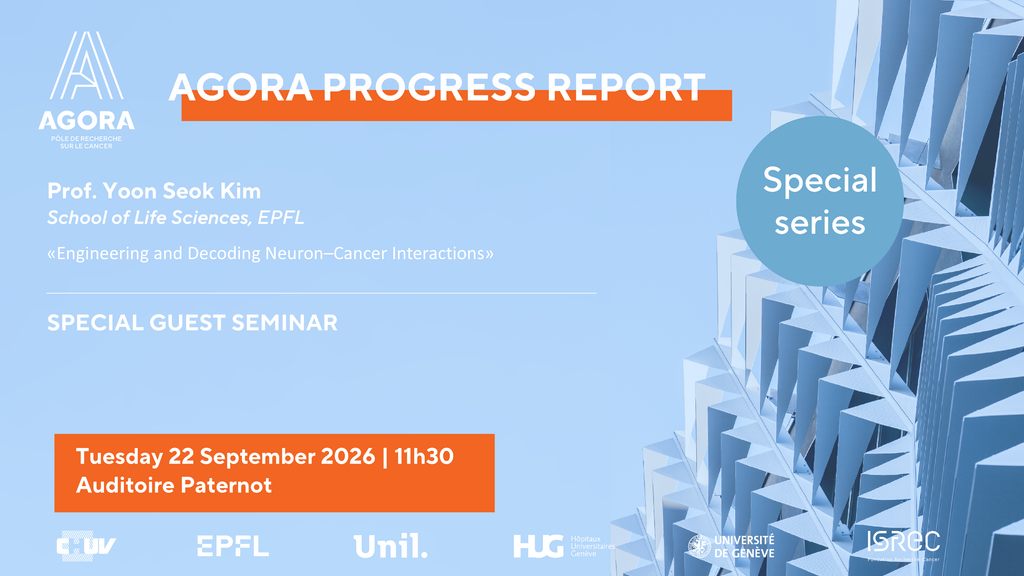
We are pleased to invite you to an AGORA PRS Special Guest Seminar on Tuesday, 22 September, with Prof. Yoon Seok Kim, School of Life Sciences, EPFL, hosted by Prof. Denis Migliorini.
ABSTRACT
Understanding how neuronal activity promotes tumor growth through paracrine signaling and electrical interactions is a central question in cancer neuroscience. My work advances two directions: 1) developing tools to interrogate and precisely disrupt these circuits, and 2) defining surface pathways in cancer neuroscience. We developed optogenetic tools that enable precise control of neuronal activity. ChRmine, a potent, red-shifted channelrhodopsin, enables precise simultaneous control of large neuronal populations and has been widely used to investigate neuron-glioma interactions. In parallel, we pioneered the use of K+-conducting channelrhodopsins (KCRs), providing an inhibitory counterpart to ChRmine. Together, these tools offer strategies to modulate neuronal activity and potentially disrupt activity-dependent glioma growth. Mechanistically, we identified a pathway linking neuronal activity to glioma growth through the NLGN3–CSPG4–PIEZO1 axis. Neuroligin-3 (NLGN3), a paracrine factor that stimulates glioma proliferation, binds CSPG4 on glioma cells and oligodendrocyte precursor cells, promoting ADAM10-dependent CSPG4 shedding. This interaction alters membrane tension and activates the mechanosensitive channel PIEZO1, leading to membrane depolarization and signaling that maintains OPCs in a stem-like state and promotes glioma growth. Together, these studies link mechanistic insight with technology development and provide new strategies to understand cancer neuroscience.
BIO
Dr. Yoon Seok Kim is an Assistant Professor of Bioengineering at EPFL, where his laboratory investigates how membrane proteins, cellular mechanics, and bioelectric signaling shape nervous-system function and disease. His research has established structural principles governing ion selectivity, enabled molecular and optogenetic strategies for controlling cellular activity, and uncovered mechanotransduction pathways through which neuronal signals promote glioma growth. He completed his Ph.D. at Stanford University with Karl Deisseroth and Brian Kobilka, and his postdoctoral training with Michelle Monje, developing a program spanning bioengineering, neuroscience, and cancer biology.
For further information please contact the AGORA team.